How to Borrow Money With Bad Credit: Stunning Easy Wins.
Article Structure

Bad credit does not block you from borrowing money. It does change your options, your costs, and the level of care you need. With a clear plan, you can get funds when you need them and start fixing your credit at the same time.
Step 1: Understand What “Bad Credit” Means
Before you apply for anything, you must know where you stand. Lenders use your credit score to guess how risky you are. A lower score means higher risk for them, so they raise interest or say no.
In many scoring systems, credit falls into rough bands. You do not need the exact number to act, but you should know which band you sit in.
| Score Range | Label | Impact on Borrowing |
|---|---|---|
| 750+ | Excellent | Lowest interest, best approvals |
| 700–749 | Good | Good approval odds, fair interest |
| 640–699 | Fair | More checks, higher rates |
| 580–639 | Poor | Limited options, high interest |
| Below 580 | Very Poor | Very few lenders, very high cost |
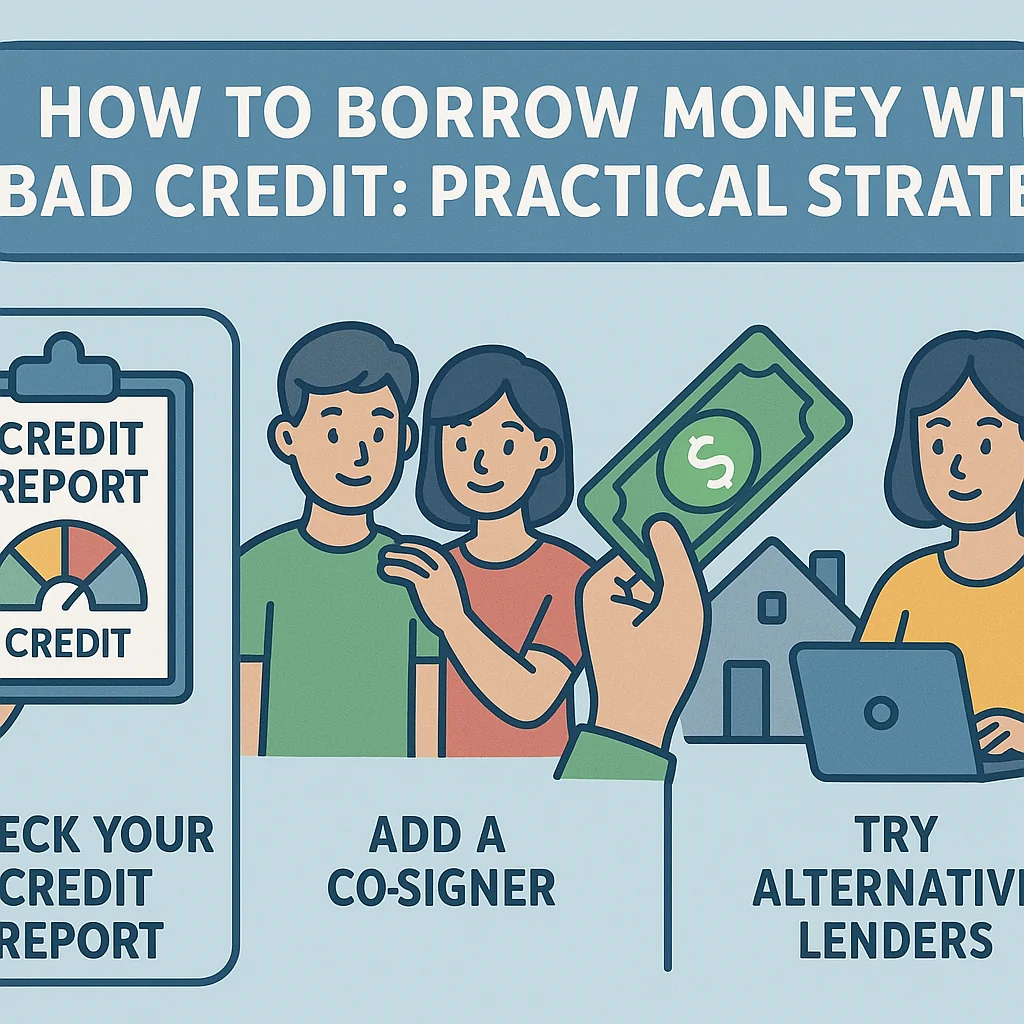
Pull your credit report from a trusted source. Check for errors like wrong late payments or accounts that are not yours. Disputing and removing one big mistake can raise your score enough to open better options, sometimes in a matter of weeks.
Step 2: Decide If You Truly Need to Borrow
With bad credit, borrowing is more expensive. So your first strategy is to decide if you must borrow at all. Many people skip this step and pay for it for years.
- Define the exact amount you need. Do not guess. If you need $600 for a repair, do not borrow $1,000 “just in case.” Extra debt means extra interest.
- Check non-debt solutions. Can you delay the purchase? Negotiate a payment plan? Ask for a hardship discount from a service provider?
- Look for cost cuts. A quick budget check may free up enough cash in a month or two, which could be cheaper than a high-interest loan.
A clear “yes, I must borrow and I know the amount” protects you from taking on debt you do not need. That single decision can save you from many short-term, high-fee products.
Strategy 1: Use a Co-Signer With Strong Credit
A co-signer agrees to pay the loan if you do not. Lenders care less about your bad credit if another person with good credit shares the risk.
Here is how this can help you:
- You may qualify where you would otherwise be declined.
- You may get a lower interest rate and better terms.
- On-time payments can improve both your credit and your co-signer’s credit.
Still, a co-signer is not a simple favor. If you pay late, your co-signer’s credit suffers. If you stop paying, the lender chases them. Only use this option if you have a realistic plan to repay and a clear agreement with the person who helps you.
Strategy 2: Offer Collateral (Secured Loans)
A secured loan uses something you own as collateral. This can be a car, savings, or other asset. If you cannot pay, the lender can take the collateral to cover the loss.
Because lenders have this extra protection, secured loans often come with:
- Higher approval odds for people with bad credit
- Lower interest than many unsecured loans
- Higher loan limits in some cases
For example, a credit union might offer a “share secured” loan that uses your savings account as backup. Or a lender might give a title loan using your car as collateral. Be careful with high-fee versions. Losing your car or savings over a small loan can put you in a deeper hole, so make sure the risk matches the need.
Strategy 3: Look at Credit Union and Community Lenders
Credit unions, community development financial institutions (CDFIs), and some local banks often treat bad credit more gently than big online lenders. They look at your income, your payment history with them, and your overall picture, not just a score.
Many of these lenders offer:
- Small personal loans with fixed payments
- Credit-builder or “starter” loans
- Emergency loans for members in short-term trouble
Fees and interest can still be high compared to prime loans, but they are often more reasonable than payday lenders or aggressive online outfits. A short visit to a local branch or a call with a loan officer can uncover options you will never see in a quick Google search.
Strategy 4: Use Credit-Builder Loans as a Side Tactic
Credit-builder loans are special tools. You borrow a small amount, but you do not get the money right away. The lender holds the funds in an account while you make monthly payments. At the end, you receive the money and a record of on-time payments on your credit file.
This strategy does two things at once. It helps you build savings and build credit. It will not solve an urgent cash crisis because funds come later. But it supports the bigger goal: making future borrowing cheaper and easier.
Strategy 5: Consider Family and Friends With Clear Rules
Borrowing from people you know can feel easier than dealing with lenders. It can also destroy relationships if you treat it casually. To keep things clean, treat it like a formal loan.
Before you accept money from a friend or relative, agree on:
- The exact amount and due dates. Write the numbers down. Include what happens if you pay late.
- Interest or no interest. Some people charge a small rate. Others charge zero but expect strict dates.
- Payment method. Cash, bank transfer, or app. Clear records protect both sides.
A simple written agreement, even on a single sheet of paper or in an email, sets the tone. It shows you take the debt seriously and plan to honor the trust they place in you.
Strategy 6: Use Online Lenders With Strong Filters
Many online lenders accept people with bad credit. Still, the range is wide: some are fair, some are predatory. Your best defense is a strict filter before you apply.
Check each lender for these points:
- Clear website with full fee and rate details
- No demand for upfront “processing” or “insurance” fees
- Regulation in your country or region, with licenses you can verify
- Real reviews on independent sites, not just their own page
Apply with only a few selected lenders instead of filling out every form you find. Many hard checks in a short period can reduce your score even more. Focus on lenders that offer pre-qualification with soft checks, where you can see likely terms before a full application.
Strategy 7: Avoid High-Risk Traps
Some forms of borrowing hit people with bad credit the hardest. They look easy at the start and turn painful later.
Approach these products with extreme care:
- Payday loans: Very short terms, huge fees, and annual percentage rates (APR) that can reach hundreds of percent.
- Car title loans: You risk losing your vehicle. Interest can stay high even if you repay on time.
- “No credit check” loans: Often hide costs in fees and inflated rates.
- Cash advances on credit cards: High fees from day one, with no grace period.
These options may make sense only in extreme emergencies where every other path is closed. Even then, limit the amount, plan a fast repayment, and focus on breaking the cycle as soon as you can.
Strategy 8: Strengthen Your Application Before You Apply
Your credit score is one part of the story. Lenders also look at your income, your current debts, and your job stability. Small improvements here can swing a “no” to a “yes,” or cut your interest rate.
Before you apply, you can:
- Reduce small existing debts. Paying down even one credit card lowers your debt-to-income ratio.
- Collect proof of income. Have payslips, contracts, or bank statements ready to show steady cash flow.
- Add a short note of explanation. Some lenders read a brief letter about a past setback (for example, a medical issue) and see recent stability as a good sign.
Think of your application as a snapshot. Clean up what you can in the background, so the picture looks as strong as possible on the day you apply.
Strategy 9: Match the Loan Type to the Purpose
Different needs call for different tools. Mixing them up can cost you far more than you expect.
Common matches include:
- Emergency cash under a year: Small personal loan from a credit union or online lender, or a family loan with a clear schedule.
- Debt consolidation: A personal loan that replaces multiple high-interest balances with one fixed payment.
- Long-term goals (study, home repair): Specialized student or home improvement loans if they exist where you live.
A clear match between purpose and product helps you avoid using short-term, high-cost tools for long-term needs. That is how many borrowers end up renewing payday loans again and again.
How to Protect Your Credit While You Borrow
Borrowing with bad credit can be the first step toward better credit if you treat the new loan carefully. Every payment you make is a signal to future lenders.
To protect and improve your record:
- Set automatic payments for the minimum amount due.
- Pay more than the minimum whenever you can to clear the balance faster.
- Track your due dates in a simple calendar or app to avoid “forgotten” payments.
- Check your credit report every few months to confirm that lenders report your payments correctly.
Picture a small personal loan of $800 that you repay on time over 12 months. The debt is not pleasant, but the pattern of steady payments can shift your score into a higher band, which cuts your costs next time you need to borrow.
When to Seek Professional Help
If you already juggle several debts and feel close to missing payments, a new loan may not be the answer. In that case, you benefit more from help with your overall structure than another credit line.
Look for:
- Nonprofit credit counseling agencies that offer budget reviews and debt management plans
- Legal aid groups if collectors harass you or sue you
- Government or charity hardship programs for housing, energy bills, or medical costs
Expert guidance can show you paths you may not see alone, such as interest freezes, structured repayment plans, or partial debt forgiveness.
Borrowing With Bad Credit Without Making It Worse
Bad credit raises the price of borrowing, but it does not remove your choices. The core steps are simple: know your score, confirm that you truly need to borrow, and pick the least costly tool that fits your purpose.
Use help from co-signers, collateral, and community lenders where it makes sense. Reject quick-cash traps that turn small problems into permanent stress. Every careful decision you make now sets up cheaper, easier borrowing in the future, as your credit slowly reflects your better habits.