Installment Loans vs Payday Loans: Stunning Best Guide.
Article Structure

Short-term cash gaps can push people to borrow fast. Two common options are installment loans and payday loans. They sound similar, but they work very differently and carry very different risks.
Understanding the differences helps you pick the option that solves a problem instead of creating a new one. A clear view of costs, terms, and consequences is more useful than any advertisement.
What Is a Payday Loan?
A payday loan is a small, short-term loan that you repay in full on your next payday. Lenders usually approve these loans quickly with minimal checks. Borrowers often use them for emergency bills, rent, or basic expenses.
Typical features include very short terms, very high interest, and automatic access to your bank account. These loans often feel easy at the start and heavy later.
Key traits of payday loans
Most payday lenders follow a similar pattern, even if the amounts and exact fees change from place to place.
- Small amounts, often a few hundred dollars or equivalent
- Due in a lump sum on your next payday or within 2–4 weeks
- High fees that translate into triple‑digit annual percentage rates (APRs)
- Payment usually taken automatically from your bank account or paycheck
- Light or no credit check; focus on income and bank access
Because the whole amount is due at once, many borrowers renew or roll over the loan, which quickly multiplies the cost.
What Is an Installment Loan?
An installment loan is a loan you repay over a set period using fixed, regular payments. Banks, online lenders, and credit unions all offer installment loans. People use them to cover bigger expenses such as medical bills, car repairs, or debt consolidation.
Installment loans come in many shapes, from small personal loans to auto loans and mortgages. Here the focus is on small personal installment loans used as an alternative to payday products.
Key traits of installment loans
Even though details vary by lender, the core structure of installment loans stays consistent.
- Borrow larger amounts than payday loans, from a few hundred to several thousand
- Repay over months or years with fixed monthly payments
- Interest rates vary from low to high, but usually lower than payday APRs
- Clear payment schedule with set due dates
- Credit check is common; income stability also matters
This structure spreads the cost over time, which can ease stress if the total cost stays within reason.
Side‑by‑Side Comparison: Installment vs. Payday Loans
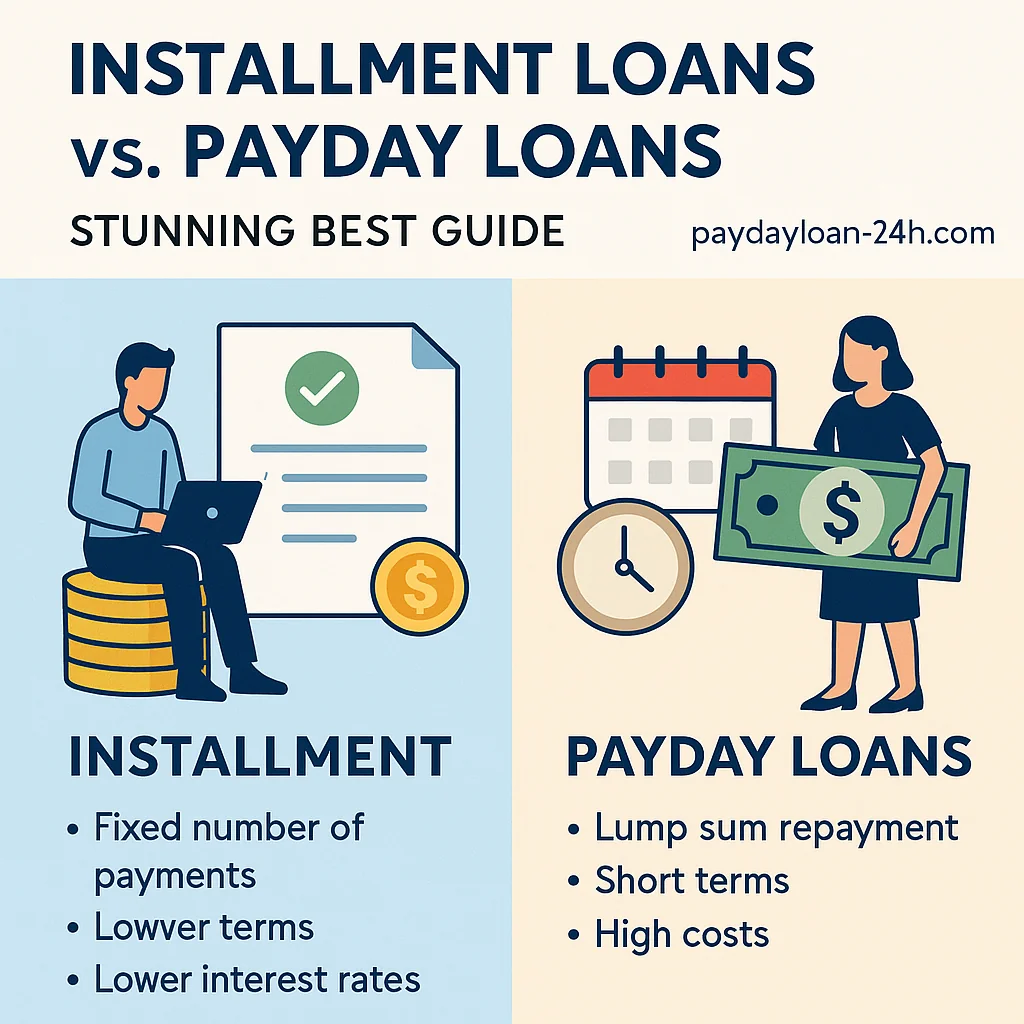
The most useful way to see the differences is to compare the main features directly. The table below summarizes the core points that affect real borrowers.
| Feature | Installment Loan | Payday Loan |
|---|---|---|
| Typical loan amount | Higher (hundreds to thousands) | Lower (small, short‑term sums) |
| Repayment structure | Fixed installments over months or years | Single lump‑sum payment on next payday |
| Loan term | Medium to long (3–60+ months) | Very short (often 14–30 days) |
| Interest / cost | Moderate to high; usually lower APR than payday | Very high fees and APR, often triple‑digit |
| Approval criteria | Credit check plus income review | Limited credit check; focus on income and bank account |
| Risk of cycle of debt | Lower if payments fit your budget | High; frequent rollovers and reborrowing |
| Impact on credit score | On‑time payments can help; missed payments can hurt | Often not reported unless sent to collections |
| Best for | Planned expenses and larger needs with time to repay | Last‑minute cash in true emergencies, as a last resort |
Both loan types give quick access to money, yet their long‑term effects differ sharply. The structure of repayment and the size of the total cost often matter more than how fast the lender sends the funds.
How Costs Compare in Real Life
Raw APR numbers feel abstract, so it helps to see how repayment looks in common situations. Imagine two people facing an urgent $500 car repair so they can keep working.
Person A chooses a payday loan. The lender charges a fee of $75 for two weeks. If Person A cannot repay in full, they renew the loan and pay another fee. After two renewals, the total fees reach $225 on top of the $500 borrowed, all within six weeks.
Person B chooses a small installment loan of $500 over 6 months with a much lower interest rate. Monthly payments stay close to the size of a typical phone bill. The total interest may still sting, but it likely stays well below $225, and there is no lump‑sum shock.
The key point: short terms plus high fees can turn small sums into heavy burdens very fast. A longer term with clear installments often gives more breathing room, as long as the interest rate is not extreme.
Pros and Cons of Installment Loans
Installment loans can be useful tools, but they carry trade‑offs that deserve a clear look before signing anything.
Advantages of installment loans
People often prefer installment loans because they feel more predictable and flexible than high‑fee payday products.
- Fixed monthly payments fit better into most budgets.
- Longer terms reduce the pressure to find a large lump sum quickly.
- Lower APRs than payday loans in many cases.
- Wide choice of lenders, including banks and credit unions.
- On‑time payments can support a stronger credit history.
For someone who wants to spread a cost over time and avoid frequent renewals, this structure can feel more manageable and transparent.
Disadvantages of installment loans
Installment loans can still cause trouble if the terms or the loan size do not match your income.
- Longer terms mean you stay in debt for more months or years.
- Interest adds up over time, especially on higher amounts.
- Late fees and penalty rates can appear if you miss payments.
- Default can damage your credit score and lead to collections.
The safest choice is a loan with payments that fit easily within your monthly budget, not one that stretches every paycheck to the limit.
Pros and Cons of Payday Loans
Payday loans exist because they solve one real problem: fast cash when no one else says yes. That strength is also the root of their biggest risk.
Advantages of payday loans
Borrowers often reach for payday loans when they feel out of options and face strict deadlines, such as rent due tomorrow.
- Very fast approval and funding, sometimes within minutes.
- Minimal paperwork and simple applications.
- Little or no traditional credit check.
- Useful in true emergencies for people with weak credit profiles.
For someone who needs a small amount for a few days and can repay in full, the speed and simplicity may feel worth the cost in rare cases.
Disadvantages of payday loans
The downsides of payday loans are serious and affect many borrowers who use them more than once.
- Very high fees lead to extreme APRs.
- Short terms create pressure and raise the risk of default.
- Rollovers and repeat borrowing often create a cycle of debt.
- Automatic withdrawals can drain accounts and trigger bank fees.
- Some lenders use aggressive collection tactics if you fall behind.
For many people, the question is not “Can I get approved?” but “Can I exit this loan on time without taking another one?” If the honest answer is no, then the product is dangerous.
How to Decide Which Option Fits Your Situation
Choosing between an installment loan and a payday loan starts with your numbers, not with the lender’s pitch. The goal is to solve a cash issue without wrecking next month’s budget.
Key questions to ask yourself
A short self‑check helps you avoid rushing into an agreement that hurts more than it helps.
- How fast do I really need the money? If the bill can wait a few days, slower but cheaper options may open up.
- Can I repay a lump sum safely? If a one‑time payment will eat most of your paycheck, a payday loan is risky.
- What monthly payment fits my budget? Look for a payment that still leaves room for food, rent, and savings.
- Is the total cost reasonable? Add fees and interest, then decide if that price is worth paying.
- Do I have alternatives? A small payment plan, a side shift, or help from family can sometimes replace a high‑cost loan.
If the honest math shows that no loan payment fits right now, borrowing more may only delay a bigger problem.
Safer Alternatives to High‑Cost Payday Loans
Before signing for a payday loan, it often pays to check at least one or two lower‑cost options. Even small changes in cost or structure can make repayment far less stressful.
- Credit union loans: Many credit unions offer small personal loans with fair rates, even for people with past credit issues.
- Payment plans with providers: Hospitals, clinics, and even some landlords may accept split payments if you explain your situation.
- Borrowing from friends or family: This can be sensitive, but a simple written agreement can keep things clear.
- Employer salary advances: Some companies let staff access part of their paycheck early at low or no cost.
- Community or charity aid: Local groups sometimes help with food, utilities, or rent so you can avoid new debt.
Even if these options feel slower or awkward, they may save you hundreds in fees and help you stay in control of your income.
Which Is Better?
For most people, a well‑priced installment loan is safer than a payday loan. The structure of fixed payments over several months gives room to breathe, and the total cost often stays lower. Payday loans sit at the edge of affordability, especially if your budget is already tight.
If you must choose between the two, focus on three points: total cost, repayment schedule, and the risk that you will need to borrow again to cover the first loan. A loan that fits your budget and lets you move on after the final payment is the choice that serves you best.