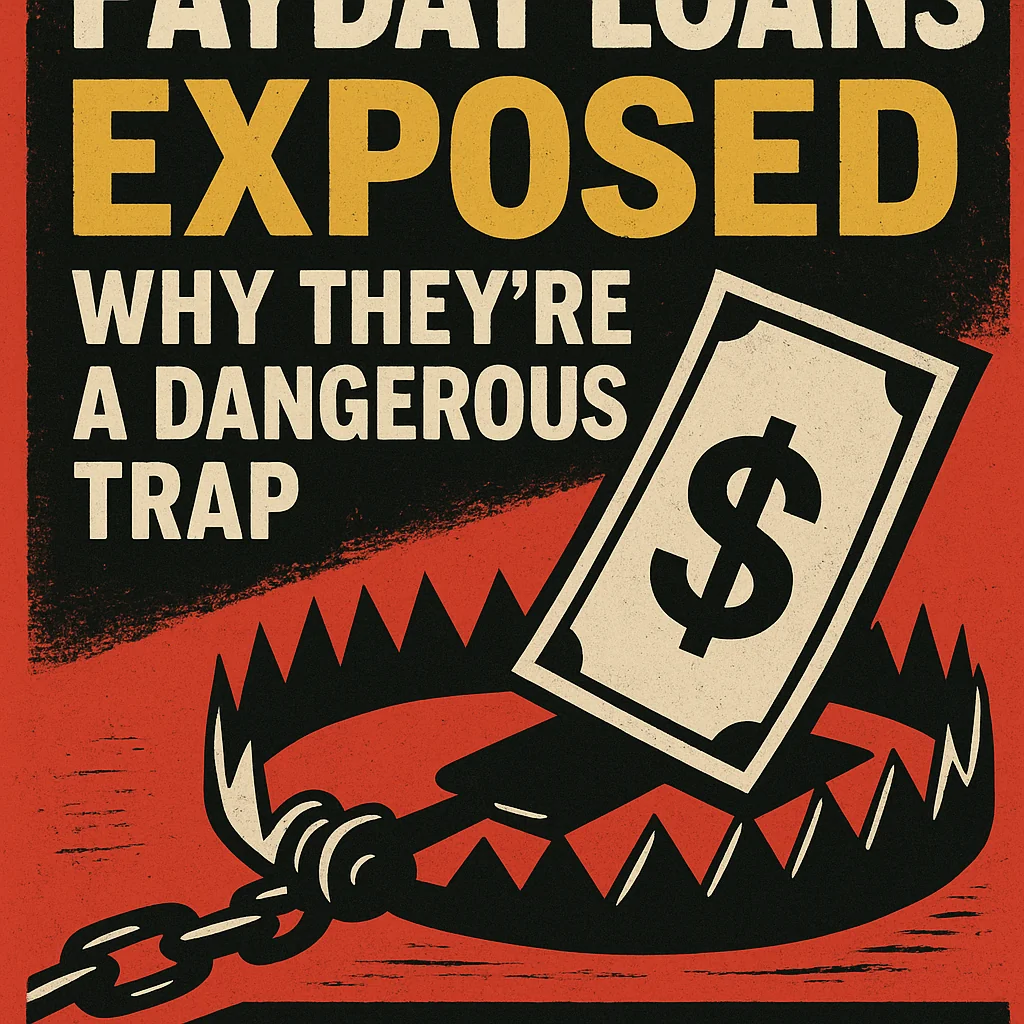
Payday Loans Exposed: Why They’re a Dangerous Trap.
Article Structure

Payday loans sit at the sharp end of short-term borrowing. They offer fast cash, but they also bring very high costs and serious risk. Understanding how they work helps you decide if they ever make sense for you, or if you should avoid them altogether.
What Is a Payday Loan?
A payday loan is a small, short-term loan that you usually must repay on your next payday. Many lenders advertise them as “cash advances” or “quick loans” with simple approval and minimal paperwork.
The typical borrower takes a payday loan of a few hundred dollars (or the local currency), then pays it back in one lump sum in two to four weeks. The lender charges a fee instead of a standard interest rate. On paper that fee looks small. In practice it often equals an annual percentage rate (APR) of 300% or more.
How Payday Loans Work Step by Step
The process is often very fast. Many people complete it during a lunch break or on their phone in under 30 minutes.
- Application: You fill in your personal details, income, and bank account details online or in-store.
- Approval: The lender checks basic information. Some do a soft credit check, others rely on proof of income.
- Funding: The lender sends the money to your bank account or gives you cash.
- Repayment: On your next payday the lender takes the full amount plus fees from your account or cashes a post-dated check.
This simplicity may feel convenient in a crisis. It also means many people accept the loan without fully understanding the total cost or the risk of rolling it over again and again.
Typical Payday Loan Features
Most payday loans share a core set of traits, even if local rules and terms differ from place to place.
- Small amounts: Often from $50 to $1,000, sometimes more, depending on local rules.
- Short term: Usually due in 14–30 days, tied to your next paycheck date.
- High fees: Commonly $10–$30 fee for every $100 borrowed.
- Single-payment structure: You pay the full amount at once, not in installments.
- Fast access: Same-day or next-day funding in many cases.
- Easy approval: Often open to people with weak or limited credit history.
This mix of speed, ease, and cost explains why payday loans feel attractive at first and painful later. A missed repayment can quickly spiral into more fees and more borrowing.
Cost Comparison: Payday Loans vs Other Options
The short term and fee structure make payday loans far more expensive than most other common forms of credit. The table below gives a simple comparison based on typical ranges.
| Type of Credit | Typical APR or Fee Range | Key Feature |
|---|---|---|
| Payday loan | 200%–600% APR equivalent | Single payment due on next payday |
| Credit card (standard) | 15%–35% APR | Revolving balance, minimum payments allowed |
| Credit card cash advance | 25%–40% APR + 3%–5% fee | Higher rate than normal card purchases |
| Personal installment loan | 6%–36% APR (can be higher for poor credit) | Fixed payments over several months or years |
| Overdraft (bank) | Varies: fixed fee or 20%–40% APR | Automatic coverage up to a limit |
The key detail is the APR equivalent. A $15 fee for borrowing $100 for two weeks may not sound extreme, but if you kept that loan for a full year at the same rate, the cost would dwarf the original amount many times over.
Who Usually Uses Payday Loans?
Payday loans often target people in financial stress. That can mean irregular income, no savings, or limited access to other credit. Yet even people with decent jobs sometimes fall into them during a rough month.
A few typical situations:
- A worker faces a medical bill two days before payday and has no savings left.
- A parent’s car breaks down, and they need it to get to work or pick up children from school.
- Someone has already maxed out their credit cards and sees a payday lender as the only remaining option.
These scenarios feel urgent. That urgency makes it easier to accept high fees in exchange for instant relief, which is why payday lenders spend heavily on quick, reassuring marketing.
Advantages of Payday Loans
Despite the risks, payday loans do have specific strengths. Understanding them makes it easier to see why people use them and when they might be the least bad option.
- Speed: Cash can arrive very fast, sometimes within hours.
- Simple criteria: Lenders often accept borrowers with weak credit scores.
- Short commitment: The debt is supposed to end with the next paycheck, not drag on for years.
- No collateral required: The loan is unsecured, based on income rather than assets.
These factors can solve a very short-term emergency, especially where no one else can lend money, not even friends or family. The problem is that the short-term fix often comes with a longer-term sting.
Major Risks and Downsides
Payday loans carry several clear dangers. These are not rare edge cases. They are common patterns that regulators and consumer groups report again and again.
- Debt cycle: If you cannot repay on time, you may take another payday loan to cover the first. Fees stack up and the balance grows.
- Very high cost: The effective APR is extremely high, so repeated use drains income fast.
- Account access: Lenders often draw funds directly from your bank account. If the money is not there, you can face overdraft fees on top of loan fees.
- Short repayment window: Paying back the full amount in one shot can be hard, especially if your budget was already tight.
- Credit damage: Unpaid loans can go to collection agencies and show up on your credit file, harming future borrowing options.
Imagine borrowing $300 to cover rent. You pay a $45 fee for two weeks. Payday comes, but now you must pay $345 and still cover utilities, food, and transport. You roll the loan over, pay another fee, and within a few months the total paid in fees can rival the original rent problem you tried to solve.
Should You Ever Use a Payday Loan?
The safest answer is that payday loans should be a last resort. In many cases they make financial stress worse, not better. Still, some people will face a moment where no other option appears to exist.
Using a payday loan may be the least harmful choice only if:
- You have a clear and realistic plan to repay it in full on the due date.
- You expect no other major bills before then.
- You have checked other options and confirmed they are not available in time.
- You fully understand the fee and any penalties for late payment or rollover.
If any of these points feel shaky, the risk of getting trapped in a cycle of borrowing jumps sharply. In that case, it makes sense to look very hard for alternatives, even if they feel slower or more awkward to arrange.
Healthier Alternatives to Payday Loans
Many people reach for payday loans because they do not know other routes, or they assume those routes are closed. In practice, several options may exist, even if they take more effort.
1. Talk to Your Creditor First
If the emergency involves a bill, contact the company that wants payment. This could be a landlord, utility provider, or medical office. Explain your situation once, calmly and clearly, and ask about short-term arrangements.
Many creditors would rather give you an extension or set up a payment plan than see you default completely. A short call can sometimes save you more money than any loan could provide.
2. Use a Credit Card or Personal Loan If Available
Credit cards and personal loans are not free, but they usually cost far less than payday loans. If you already hold a card, check the rate and fees for purchases and cash advances. Cash advances cost more, yet they still often beat payday loan pricing.
If you have time, a small personal loan from a bank, credit union, or online lender with installment payments can spread the cost in a more manageable way.
3. Ask for Help From Your Network
Many people feel ashamed to ask for help from family or friends. Yet a small private loan with clear terms, or even a one-time gift, may spare you from months of high interest and fees.
Set clear rules: agree on the amount, repayment schedule, and what happens if a payment is late. Writing it down protects both sides and keeps the relationship steady.
4. Use Community and Non-Profit Support
In many regions, community organizations offer support for food, housing, energy bills, or medical costs. This support can take the pressure off your budget long enough to avoid high-cost loans.
Look for trusted charities, religious groups, or government programs that focus on emergency aid, rental help, or debt advice. A short search or a call to a local advice service can point you to options you did not know you had.
How to Protect Yourself if You Already Have a Payday Loan
If you already took a payday loan and feel stuck, you still have options. The key is to act early, before fees build up.
- Check the contract: Read the terms, due date, total repayment amount, and any rollover rules.
- Contact the lender: Ask about payment plans or hardship programs. Some lenders may stretch the term or reduce fees.
- Prioritize essentials: Make sure food, housing, and utilities remain top priority. Do not sacrifice essentials to roll over high-fee debt if other solutions exist.
- Seek free debt advice: Many non-profit agencies offer guidance on dealing with payday lenders and other creditors.
Taking these steps does not erase the debt, but it can slow the damage and help you build a path out instead of sinking deeper with each paycheck.
Are Payday Loans Worth It?
Payday loans offer speed, simplicity, and access for people who feel shut out of traditional finance. The tradeoff is huge cost and significant risk of a debt trap. For most people, they are a poor choice compared with almost any other legal borrowing option or support scheme.
If you ever consider a payday loan, pause and ask three questions: Do I fully understand the cost? Can I truly repay in full on time? Have I checked every other realistic option? If any answer is “no,” stepping back is usually the wiser move for both your wallet and your peace of mind.